|
November 5, 2007: This website is an archive of the former website, traprockpeace.org, which was created 10 years ago by Charles Jenks. It became one of the most populace sites in the US, and an important resource on the antiwar movement, student activism, 'depleted' uranium and other topics. Jenks authored virtually all of its web pages and multimedia content (photographs, audio, video, and pdf files. As the author and registered owner of that site, his purpose here is to preserve an important slice of the history of the grassroots peace movement in the US over the past decade. He is maintaining this historical archive as a service to the greater peace movement, and to the many friends of Traprock Peace Center. Blogs have been consolidated and the calendar has been archived for security reasons; all other links remain the same, and virtually all blog content remains intact. THIS SITE NO LONGER REFLECTS THE CURRENT AND ONGOING WORK OF TRAPROCK PEACE CENTER, which has reorganized its board and moved to Greenfield, Mass. To contact Traprock Peace Center, call 413-773-7427 or visit its site. Charles Jenks is posting new material to PeaceJournal.org, a multimedia blog and resource center.
Search
site - New! Calendar - Calendar
Archive Contents - Archives - War Crimes - GI Special - Student Activism - Links |
|


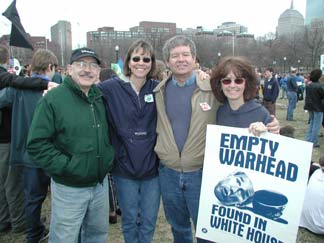
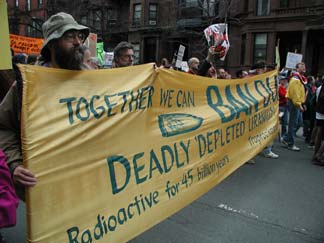
Go to Boston March Photo-album
Tens of thousands rally in Boston for peace
By
Jenna Russell, Globe Staff, Globe Correspondent, 3/30/2003
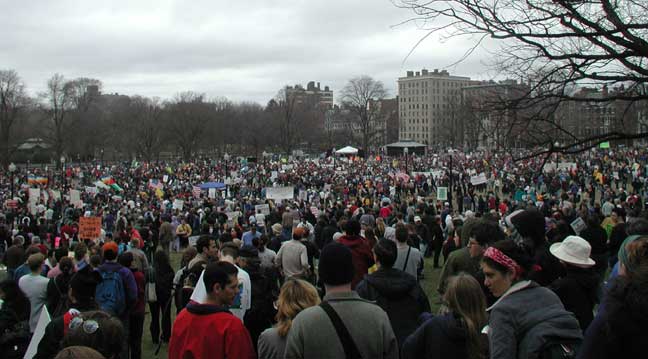
Tens of thousands of people from across New England and beyond
converged on a damp, windswept Boston Common for a massive antiwar rally
yesterday, then marched through the city, saying they hoped to show the world
that not all Americans support President Bush and the war in Iraq.
While authorities estimated the crowd at about 25,000, no arrests
were reported by Boston police. Hundreds of officers were mobilized to monitor
the generally peaceful gathering, one of the city's largest in decades, which
stretched over several acres on the park's north side. Dotted with handmade
signs and rainbow flags, the crowd included students, parents with young
children, senior citizens, and Baby Boomers, who said the scene reminded them
of 1960s Vietnam War protests.
''We're here today to remind our country that by definition, war
is a failure for the human race,'' Brian Corr, a leader of the national group
Peace Action and the rally's moderator, told the throng as helicopters hovered
overhead, the elegant brick architecture of Beacon Street behind him. ''We're
here today because we're serving as the conscience of our nation.''
Away from the stage area, where spectators cheered a two-hour
program of political speeches and music, some young people drummed on plastic
buckets and played harmonicas, while families socialized, lounging on the muddy
grass or in lawn chairs. Protesters came from Rhode Island and Maine, Cape Cod
and Gloucester, and from college dorms across the street from the Common,
bearing signs reading, ''Shock and Awe and Shame,'' ''Make Love Not War,'' and
''Don't Give Smart Bombs to Dumb Presidents.''
''This is my motherland, but if my mother kills, I'm going to have
to take her to the authorities, because no one has a right to kill, even my
mother,'' Boston City Councilor Felix Arroyo told the crowd.
Many protesters said they have little hope that Bush will hear
their message, but came to express concern and anger anyway. ''I want to look
back and know that I did something, and I want the rest of the world to know
that we're not all for the war,'' said Patty Grant, 52, of Boulder, Colo., who
protested the Vietnam War as a college freshman, and came to Boston this
weekend to visit her daughter, a freshman at Emerson College, who joined her on
the Common.
Boston's largest war protest took place on the Common in October
1969, when Senator George McGovern was the featured speaker before a crowd
estimated at 100,000 people. Since then, thousands have gathered in the park to
protest US policy in El Salvador and the Gulf War. Last November, about 15,000
people came out against the threat of war in Iraq; since the war began 10 days
ago, smaller protests have occurred throughout the city, leading up to
yesterday's event.
Organizers said they were pleased with the turnout, which met
their expectations.
War supporters appeared in much smaller numbers at the edges of
yesterday's rally. Wearing a hard hat plastered with pro-war stickers, one man
bellowed at the crowd from atop a lamp post.
''Did you forget 9/11? Our troops need support,'' he shouted. The
man tumbled 15 feet to the ground after the plastic dome he was holding popped
off the top of the pole. Some spectators cheered; one asked if he was hurt, but
got no answer. Limping away, the man declined to give his name but identified
himself as an iron worker from Chinatown who hurried over to the Common on his
lunch hour. ''America forgets too easily about 3,000 people they stole from us
at the World Trade Center,'' he said.
Some protesters carried conflicting passions. Rebecca Love, 24, an
insurance claims specialist from Brookline, worries for the safety of her
boyfriend, Scott Countryman, 26, a lance corporal in the Marine forces who is
participating in the charge toward Baghdad. Love said she supports war ''when
necessary,'' but joined yesterday's protest, her first, because she feels the
United States has broken international law with its invasion.
''There are moments when you sit there and you're torn, because I
want to support him, but I can't support this war,'' she said. ''He's not
allowed to speak out against this war, so I have to carry on with our rights.''
Dressed in black and carrying signs that read ''Rich People Lie,
Poor People Die,'' three dozen members of the Peoples Global Action Network,
wearing handkerchiefs on their faces, planned to engage in civil disobedience,
but their plans were thwarted by a group of special operations officers from
the Boston Police Department, who surrounded them.
''I've pretty much given up on the idea that simple manifestations
of protest accomplish anything,'' said Evan Greer, a 17-year-old member from
the Cambridge School of Weston. ''Civil disobedience is a key way to go. The
Bush administration does not listen to the people.''
Organized by the Greater Boston group United for Justice with
Peace, which decided not to seek arrests and instead obtained permits for the
event from the city, the rally stayed on schedule, with marchers streaming out
of the park promptly at 1:30 p.m. They headed down Beacon Street to Hereford
Street before returning to the Common by way of Boylston Street. Some roads
were closed to traffic for several hours, allowing hundreds of demonstrators to
stage ''die-ins'' at several locations by lying down in the empty streets. Some
lay quietly; others chatted on cellphones.
Near the die-in at Arlington and Boylston streets, about 100 young
men, some of them veterans, screamed ''Traitor!'' and ''Get Saddam!'' at the
protesters. But the two sides found some common ground: When the pro-government
group started singing the National Anthem, several hundred antiwar
demonstrators joined in.
When protest permits expired about 4 p.m., most die-in
participants cleared the streets, but a handful refused to get up and blocked
Charles Street between the Common and the Public Garden.
''I believe in peace,'' said Kate Crockford, 19, of Roslindale, as
she reclined on the pavement, dressed all in black and wearing sunglasses. ''I
believe everybody should lie in the street. We can't all be arrested.''
Told that she could face a hefty fine if arrested - student
members of the National Lawyers Guild were on hand to advise protesters of
their rights - Crockford decided to move along, as a line of police on horseback
closed in. Another woman stayed on the ground despite the warnings, and was
picked up and carried to the sidewalk by police.
With streets open again, dozens of protesters remained by the park
into the early evening, chanting and crowding back into the streets every time
red lights stopped traffic. Police lined the sidewalks on both sides of Charles
Street, and pulled out plastic handcuffs, while officers on motorcycles and
horseback forced the crowds back.
After the march, as the crowd began to disperse, about 70 Muslims
dressed in white turbans and robes attracted onlookers as they removed their
shoes, turned east in unison, and began to pray. The Muslim men held court on a
patch of grass for nearly an hour as many people observed silently.
The Muslims appeared at the Common by coincidence, after many of
them had completed a two-month ''walk for guidance'' from Mount Vernon, N.Y.
Megan Tench, Corey Dade and Douglas Belkin of the Globe Staff
and Globe correspondent Ray Henry contributed to this report.
Go to Boston March Photo-album